The story of our conference table, and a habit we can't seem to break.
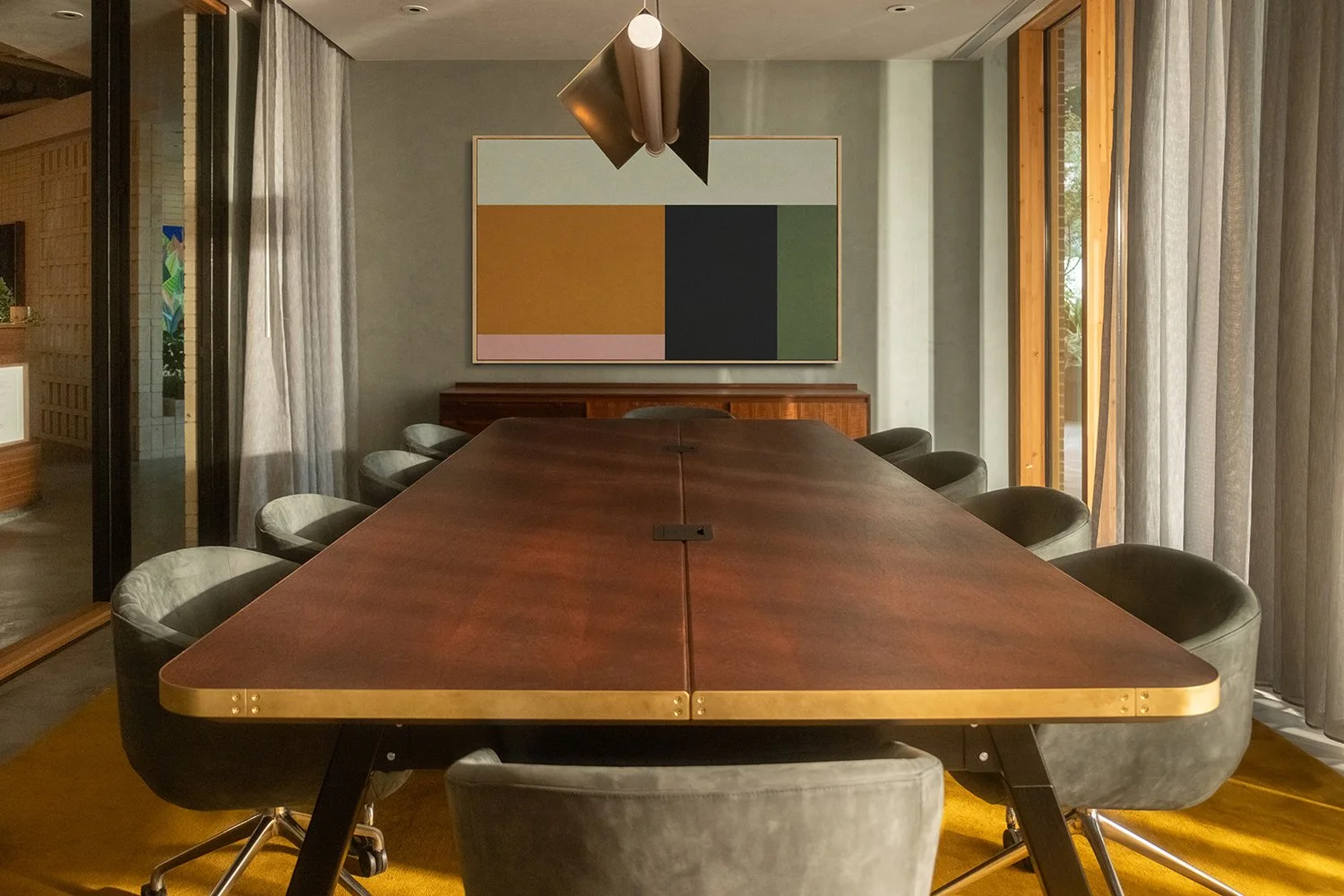
“The new top was too big to make in one piece. That meant a seam, right down the middle.”
Our conference table is a custom design that began with another piece of furniture entirely. A credenza we didn’t design, but found at a thrift store and fell for the finish right away: a deep, reddish mahogany with the kind of warmth that usually takes a few decades to earn. We brought it home, and it became the piece the rest of our conference room had to live up to.
A good table with the wrong top
Around the same time, a conference table came our way as a donation from our friends at SKG, design and furniture specialists. The bones were excellent. The top was not. Rather than pass on it, we decided to keep what worked and make a new top worthy of the credenza.
It started the way most of our work does, with sketches. Then a 3D model, so we could check the proportions against the room, the chairs and the light. Then the part where things get real: sitting down with Philip Hernandez of Domi Goods, a local designer and fabricator, to work through every detail.
Matching new to old
Getting new wood to sit comfortably next to old wood is harder than it sounds. Wood keeps changing color as it ages, and the credenza had a long head start. We went through several rounds of samples, holding each one up against the credenza in different light, before we found one that felt like it belonged.
The problem with a big table
The new top was too big to make in one piece. That meant a seam, right down the middle.
The usual move is to try and hide it. Pull the two halves tight, fill the gap, maybe cover it with a strip of trim, and hope nobody looks too closely.
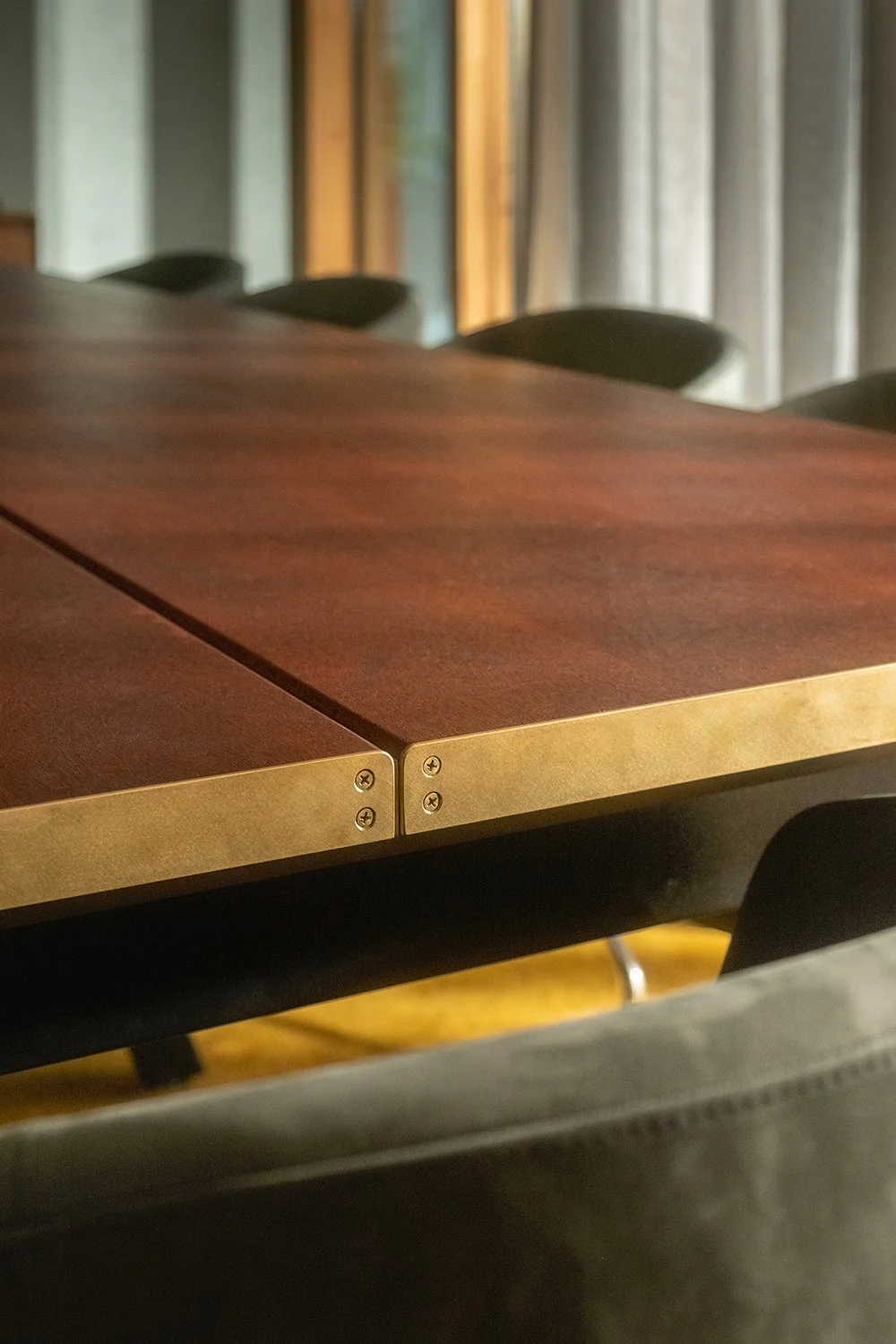
We went the other way. We highlighted the seam. Each half got a rounded, bullnose edge where it meets the other, so the seam reads as a line someone drew on purpose instead of a gap someone couldn't avoid. That same rounded edge shows up across the room, in the storefront window trim and the metalwork. Even the brass band around the table's edge is held on with fasteners you can see. Nothing is hiding. Nothing is pretending.
Why we keep doing this
This isn't a one-off. Whenever two materials or two pieces meet in our work, our instinct is to show the joint rather than cover it up. A joint tells you how something was made. Trim hides it.
Part of that is honesty. We'd rather a material look like what it is. Part of it is craft: a visible joint has to be good, because there's nothing to hide behind. And part of it is simply that we find it more beautiful. The places where things come together are often the most interesting parts of a room.
The table lives in our conference room at 1515 E Cesar Chavez. If you're ever in East Austin, come sit at it. Brett can make you a killer cortado, and you can run your hand down the seam yourself. You can tell a lot about the people who made something that way.